
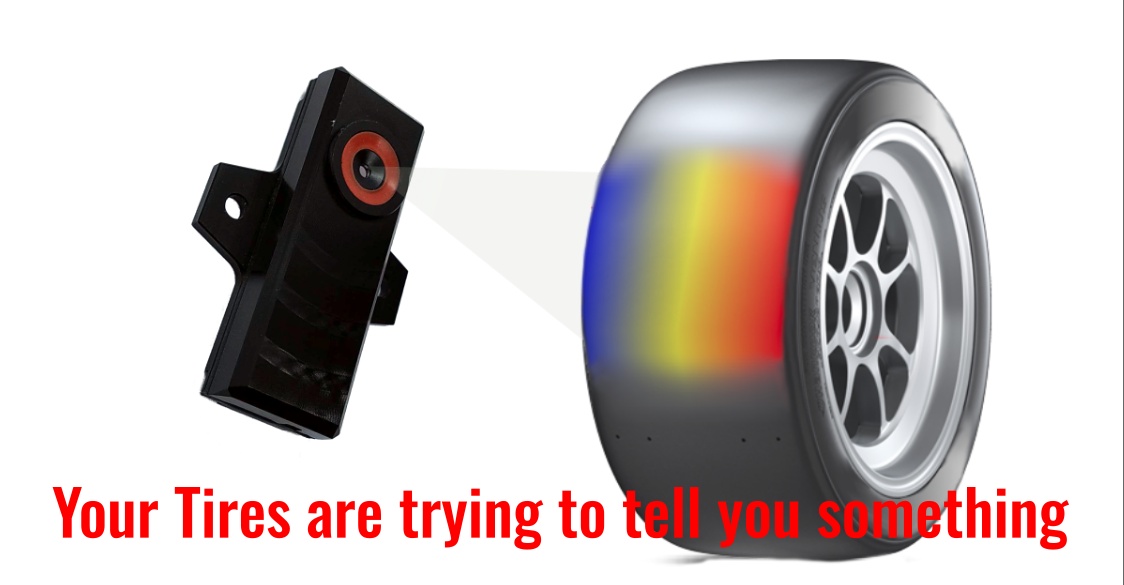
Your tires are the only part of your car that touches the track. Everything else: your suspension geometry, your spring rates, and your tire pressures exists to help those four contact patches do their job as effectively as possible. And yet, for most amateur and club racers, the tires remain a black box. You feel understeer, you feel oversteer, but why it’s happening, and where, often comes down to guesswork.
Tire surface temperature data changes that. Using a multi-zone thermal sensor like sensors from Texense, Izze Racing or Autosport Labs TireX, you gain a real-time window into what each part of each tire is actually doing and a clear, data-driven path to making your car faster.
Why Temperature? The Physics of Grip
Rubber generates grip through a combination of mechanical interlocking with the track surface and viscoelastic deformation: the tire compound flexes and flows into microscopic surface irregularities. Both mechanisms are temperature-dependent. Most performance tires, from street-oriented track compounds to purpose-built race rubber, have an optimal operating temperature window. Too cold, and the compound is stiff and glassy, lacking the compliance to grip well. Too hot, and the compound degrades, blisters, or loses structural integrity.
But there’s a more fundamental insight beneath the temperature window concept: heat is generated by work, and work requires contact pressure. A part of the tire pressing hard against the track generates friction and therefore heat. A part of the tire that is barely in contact (or lifted off entirely) generates very little heat at all.
This means the distribution of temperature across the tire face is a direct map of the distribution of contact pressure. Uneven temperatures mean uneven pressure. Uneven pressure means you’re not using the full width of the tire. And that means you’re leaving grip on the table.
The goal is even temperature across the full width of the tire, at all four corners. When heat is distributed uniformly, contact pressure is distributed uniformly, and you’re extracting maximum grip from every millimeter of tread.
The Ideal Temperature Profile
Before diagnosing problems, it’s worth defining what you’re looking for. On a well-set-up car with correct pressures and alignment:
- All four tires should be operating within their optimal temperature range for the compound (consult your tire manufacturer’s data sheet as this varies significantly by compound and construction).
- Across each tire, inner edge, center, and outer edge temperatures should be within roughly 5–10°C of each other under representative working conditions.
- Left-to-right balance at each axle should be broadly symmetrical, adjusted for track asymmetry on circuits with a strong directional bias.
With a sensor like the TireX configured to report 4 or 8 zones per tire, you can observe this distribution in real time from the pits via telemetry, or analyze it in detail in post-session review.
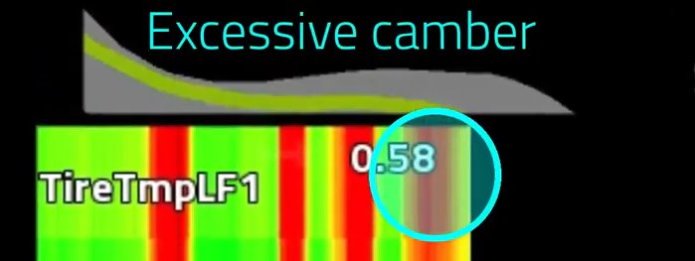
TireX thermal data revealing uneven temperature distribution: a classic sign of excessive negative camber loading the inner edge.
Camber: The Most Common Culprit
Camber — the inward or outward tilt of the wheel relative to vertical is one of the most powerful and most commonly misunderstood suspension settings.
A tire at zero camber presents its full tread width to a flat road in a straight line. But when the car corners, body roll and suspension geometry cause the contact patch to tilt outward relative to the road. The outer edge of the tire bears disproportionately more load than the inner edge.
Negative camber (top of wheel tilted inward) compensates for this. As the car rolls into a corner, the negative camber works against the roll angle, keeping the tire more upright relative to the road and preserving the contact patch. The typical result is improved cornering grip and lateral acceleration.
Reading the Camber Signature
❌ Too Little Negative Camber
Outside edge overloaded in corners. Inner edge underutilised. Outer shoulder wear and reduced peak cornering grip.
❌ Too Much Negative Camber
Inner edge runs hot even on straights. Outer edge never reaches operating temperature. Reduced straight-line traction and inner shoulder wear.
✅ Correct Camber
Even distribution across all zones. Slight center warmth is normal. Full tread width contributing to grip in both straights and corners.
⚠️ Track-Biased Heating
Overall high temps on inner zones. Common on clockwise circuits where right-handers dominate — left-side tires are consistently loaded harder.
Camber’s effect is most visible during cornering loads. On a circuit with many slow, high-load corners, you may need more aggressive camber settings than on a high-speed, low-lateral-load layout. Real-world temperature data beats any generic setup guide — because your car, your tires, and your circuit are unique.
Tire Pressure: The Shape of the Contact Patch
Tire pressure governs the shape of the contact patch. At the correct pressure, the carcass deforms in a controlled way that maximises contact area without stressing the tread compound unevenly. Pressure errors produce characteristic temperature signatures that are easy to read once you know what you’re looking for.
Under-Inflation: Hot Edges, Cool Center
An under-inflated tire cannot maintain its shape under load. The sidewalls flex excessively and the center of the tread arches upward, reducing center-tread contact pressure. The tire is effectively rolling on its outer edges, with the middle of the tread contributing far less than it should.
❌ Under-Inflated
Both edges hot, center cool. Carcass is deforming — sidewalls overworked. Risk of structural fatigue and sudden failure under sustained load.
❌ Over-Inflated
Center overloaded, edges barely contact the road. Car will feel nervous and darty. Reduced grip and uneven center wear.
Over-inflation produces the inverse: a tire that is too rigid to deform and conform to the road surface. Instead of the full tread width contacting the track, the tire rides on a narrow center band with the shoulders barely touching.
Tires heat up significantly on track and pressure rises accordingly: a tire set at 28 PSI cold may be running at 34–36 PSI after several hot laps, depending on compound, ambient temperature, and track surface. Most tire manufacturers specify hot running pressures, not cold set pressures. Always measure pressures immediately after coming off the circuit and work backwards to set your cold targets consistently.
Toe Settings and Edge Temperatures
Toe: the angle of the wheel relative to the direction of travel affects tire temperatures in subtler ways than camber but is still clearly legible in the data. Both toe-in and toe-out introduce a scrub angle: the tire is asked to move slightly sideways as it rolls forward, generating heat at the leading edges of the contact patch.
- Excessive toe-in or toe-out will appear as elevated edge temperatures that persist even on straight, a key distinction from camber-related heat, which tends to be cornering-specific.
- Rear toe-in is common for stability under power, but too much will run the rear tires hotter than necessary, reducing available rear-axle traction.
- Front toe-out can sharpen turn-in response but at the cost of straight-line heating and tread wear on the inner leading edges.
Temperature data helps you calibrate exactly how much toe is actually working versus how much is simply generating heat; a distinction that’s nearly impossible to make by feel alone.
Corner Balance and Load Distribution
Beyond camber and pressure, tire temperatures reveal information about weight distribution. If one tire on an axle consistently runs hotter than its partner, that corner may be carrying more load than the geometry intends.
Common causes include:
- Corner weight imbalance: If the chassis isn’t properly corner-weighted, one side of an axle carries more static load, and temperature sensors will reflect this as an asymmetric heat pattern.
- Spring rate mismatch: A stiffer spring on one side will cause that corner to carry more dynamic load in certain conditions.
- Damper settings: An over-damped corner may prevent weight from transferring onto that tire correctly, keeping it underloaded relative to its partner.
Look at axle-to-axle balance as well. Chronic overheating at the front axle relative to the rear can indicate brake bias issues, aerodynamic imbalance, or suspension geometry producing excessive understeer. The reverse suggests the rear is working harder: potentially a sign of too much rear brake bias or insufficient rear downforce.
Practical Session Workflow
Here’s a repeatable approach to using tire temperature data in a race or track day session:
-
Establish a representative baseline. Run 3–5 laps at consistent, realistic pace. Avoid using your out-lap or a one-lap push; you want steady working conditions, not transient data.
-
Record temperatures across all four corners. With TireX reporting 4 zones per tire on all four corners, you have 16 channels of thermal data. Organise them as Inside / Center-Inner / Center-Outer / Outside for each wheel position.
-
Look for patterns, not outliers. A single corner that got caught under heavy braking doesn’t tell you much. Look for gradients that repeat consistently across multiple laps.
-
Prioritise the most loaded tires first. On front-heavy or front-drive cars, start with the fronts. On rear-drive cars under hard acceleration, the rears may show the most diagnostic variation.
-
Make one change at a time. Adjust camber, or adjust pressure, and not both simultaneously. Re-run and compare. This sounds obvious but is routinely violated under time pressure in the paddock.
-
Account for track and ambient conditions. A cold or damp track suppresses overall temperatures and can mask pressure-related patterns. Factor ambient temperature into your interpretation, especially in variable conditions.
Seeing It All in Real Time with TireX
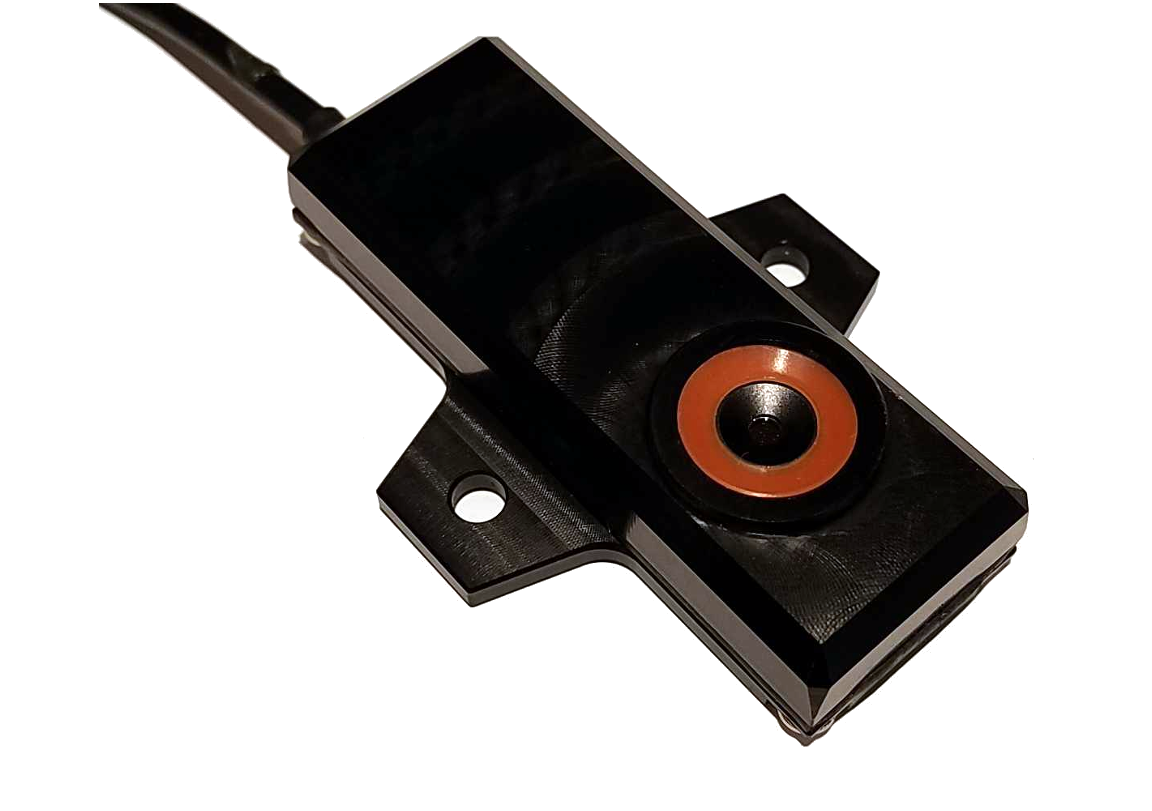
The TireX sensor: CNC-machined aluminum, IP65-rated, with a 110° field of view that covers the full tire width even in tight fender clearances.
The TireX is purpose-built for exactly this kind of analysis. Its 110-degree field of view covers the full tire width even in tight wheel wells, and support for up to 16 temperature zones per tire provides resolution that was previously only available to professional motorsport teams. With the 4-corner kit, you’re capturing up to 64 channels of thermal data simultaneously, enough to diagnose camber, pressure, load distribution, and toe effects with genuine confidence.
Integrated with the RaceCapture telemetry system and Podium live data platform, you can watch tire temperatures evolve in real time from pit lane, identifying what needs to change before the car even comes in. For post-session analysis, the full time-series data lets you correlate temperature changes with specific corners, braking zones, or track sectors.
TireX Advanced Thermal Sensor
Up to 16 temperature zones per tire. 64 total channels with a 4-corner kit. Real-time CAN bus telemetry. Compatible with RaceCapture, AiM, MoTeC, AEM and more.
Shop TireX →Tire temperature data won’t make a slow driver fast on its own. But for drivers who are already consistent, it removes the guesswork from setup decisions. On a balanced, well-tuned car, the remaining performance comes from the driver, not from fighting inadequate contact patches.
The data is there. Your tires have been trying to tell you something all along. Now you can listen.
Learn more about the TireX thermal sensor at autosportlabs.com, and see the full technical documentation at the Autosport Labs wiki.